Last week, I posted about resting and the importance of taking the time for self-care without feeling guilty. It’s a common problem in our go-go-go world, where there are always errands to run, household chores to get through, work to do, exercise hopefully, eating right, not to mention connecting with family and friends.
It’s not surprising that the mindfulness movement is gaining traction. People are burning themselves out and have forgotten how to be still. How to just BE.
I am so fortunate to have the support and the space to rest when I need to and to have lots of time, now that I’m not working, to spend time reflecting and contemplating my navel. Not really, I promise.
When your body aches from fatigue, it’s pretty tempting to sit around as much as possible. The mental stress aside, spending too much time sedentary is really hard on your body, especially if you have MS. Obviously I’m not talking about people that are in a relapse or are paralyzed from the monster.
Being as active as possible is now the recommendation of doctors, which applies to all humans, not just warriors and spoonies. It works for me. It takes me a long time to get moving in the morning, but when I spend too much time in bed, the weight of the fatigue and the various pains become overwhelming. Forcing myself to get up and accomplish just one task, distracts me and often I am able to accomplish much more than I expected.
That’s where the real problem comes in. I start going, and I have a hard time stopping. My body protests but my brain, and the stupid determination that has mostly served me well, says ‘Just. One. More. Thing.’
All good, we all need to push ourselves, that’s the human spirit. Not so good when your body ends up going on strike and you spend the next three weeks in bed. Yeah, I think that’s called a need for BALANCE.
The hummingbird has long been a personal symbol. I remember the first time I saw one as a child in Alberta, where they are quite rare as I recall. It was magical, this tiny bird with wings that moved at an incomprehensible speed.
I found out as an adult that my Oma loved hummingbirds too. Since she died, I have had numerous experiences with a hummingbird flying directly in front of me and hovering for a minute or more, often at times of personal change or turmoil.
I think the reason it speaks to me, is that the wings represent the speed of my brain. Not that I haven’t learned to quiet my thoughts and have moments of peace, but when I get going on a task my brain is always ten steps ahead of what’s humanly possible. Then, because of the damn monster, my body konks out long before my brain is satisfied.
The hummingbird’s body always stays calm, though. That’s the essence of the hummingbird I try to focus on now. The balance between the busy and the calm. Push yourself, but don’t push too hard. Expect great things from yourself but be gentle with yourself too. Pacing yourself, that’s the golden ticket.
Brain fog causes issues with processing and comprehension. Here are some things to remember to help conversations flow more easily when you’re speaking to someone with brain fog.
1. Don’t change the subject.
It’s a very wavery tightrope to collect your thoughts and articulate them clearly when your brain is drowning in cotton. When you change the subject mid-conversation, often we can’t retrieve the original thought that just might have been world-altering.
2. Don’t ask questions until we’re finished speaking.
Again, any interruption throws the train off the tracks so even if you think being an attentive listener means asking questions, hold back. It can be a ridiculous feeling of success to process and articulate a complete thought when your brain doesn’t want to cooperate so please allow the time and space for that to happen, without interrupting.
3. Don’t talk to us when we’re trying to complete another task.
Multi-tasking is the gold standard for success these days, everyone is SO BUSY! Brain fog allows a person to only complete the simplest of tasks, one at a time. Please don’t try to chat if they are trying to cook or even tie their shoes. Every task takes so much mental (and physical) energy, it is impossible to split the focus.
4. Speak clearly and slowly, don’t mumble.
It takes as much effort to listen and process the message receiving information when Charlotte has spun her web so thoroughly in your noggin. Again, allow time and space for processing and for Pete’s sake, speak loudly and clearly. But not like we’re morons. Thanks.
5. Accept a grunt as a polite response.
Sometimes carrying on a conversation is more than we can handle. Don’t take it personally. It’s sort of like when toddlers ‘hit the wall’ – “Complete meltdown approaching, back away, BACK AWAY!”
Brain fog affects many people living with chronic illness. For many, it never goes away, it just changes in its severity. I hope these tips help your next conversation with a foggy to proceed without too many hiccups.
Do you have any tips to add? What is the most difficult aspect of conversing when you’re suffering from brain fog?
Walking the tightrope of ms relapse prevention and symptom management while juggling life stress, heat intolerance, sensory overload, the ogre of depression and its craptastic partner-in-crime, anxiety.
We spent an incredible weekend in Vancouver, going to see the Psychedelic Furs, a band I started listening to in 1985, the year I met my husband. Nostalgia aside, they were maybe not the most exciting live band but we had a whole second show play out in front of us. It ended with a very eccentric, obnoxious man throwing his drink in his ex’s face, spraying all of us nearby. Oh, the drama.
Going to Vancouver usually stresses me out with all the traffic, the dreaded George Massey tunnel, the smells, the noise, the people everywhere. The chaotic energy of a big city is exhausting but it’s worth it to spend a night away watching live music with my husband.
This time traffic was mellow, even on a weekend at the height of summer. Everything fell into place beautifully everywhere we went so there was little stress and the monster was quiet so I felt pretty great, all things considered. Happy hour cocktails at the Cactus Club may have helped a bit, too. 🍹
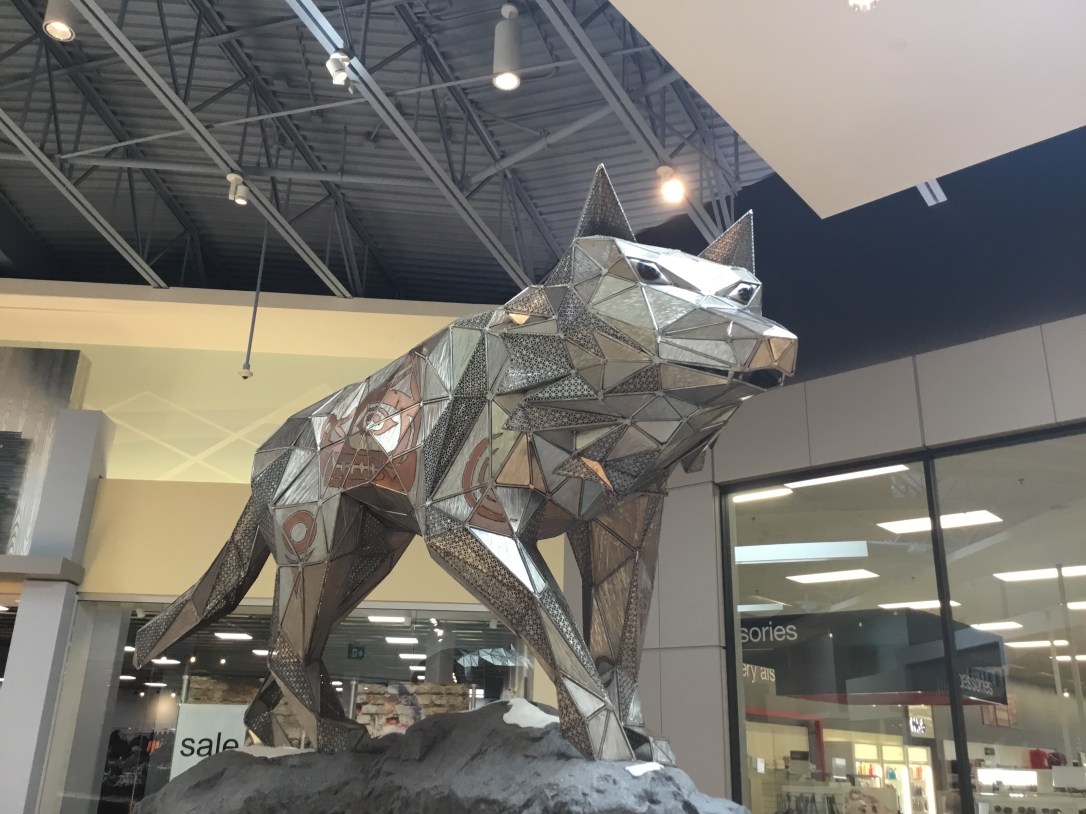
Even the drive back out to the ferry, because we left the city early and went to check out the new mall, Tsawwassen Mills, was a fun, stress-free adventure. I’m not a mall rat and typically think a mall is a mall is a mall but they have done a very thoughtful job of incorporating First Nations artwork and unique elements that make walking around the ginormous space a mall experience unlike any I’ve had before.
First Nations metal wolf sculpture
Part of the joy of being an island-dweller is the hurry-up-and-wait experience of riding the ferry. I’m mostly patient and can amuse myself pretty easily but we all know how hot this summer has been in the northern hemisphere. Sitting in a truck on the end of a man-made jetty covered in concrete, full of metal cars and huge semi-trailers is a special kind of torture for every traveller.
Heat sensitivity is a common symptom of multiple sclerosis. Being the annoying mofo that it is, my body can tolerate heat or cold just fine most of the time. Until it suddenly can’t and all hell breaks loose. I think my thermostat’s broken.
So, my sweater is hanging off the sun visor shielding my body from the sun, doors and windows all open to catch the cool ocean breeze, all is well. Then the wind dies, the sun’s still beating down on me through the side window and a mushroom cloud of heat wafts up from the pavement.
Knock knock. Who’s there?
Hot, too hot.
Brain frying, can’t think
Panic starts, ears ringing.
Hello Anxiety.
Anxiety is another special gift the monster has given me in the last few years. It is closely related to depression in that they share the all-encompassing feeling of doom. The only thing that makes it controllable is knowing that it is a result of the damage in my brain, it is not real.
On the tarmac, I ended up going into the relative cool of the marketplace, to be faced with all the other overheated humans seeking relief.
Hello Sensory overload.
Tune it out. Blinders on. Focus on stationary objects.
Jewelry. Oh, pretty. Slowly inspect.
Cool down. Calm down.
Sea salt scrub. 50% off. Sure!
Hot, too many people.
Stuffy. Loud. Too much.
When I got back to the car, we had the bright idea of using the air-conditioning. Oh, sweet relief! I don’t love idling a car for any longer than necessary but when it comes to being either environmentally responsible or saving my brain and body from total meltdown, I will be unapologetically selfish. Please remember this if you’re tempted to judge someone for idling their car in the future. It can be a case of life or death for some people in this kind of heat.
People always worry about the dogs but, you know, humans.
Just after we boarded, a camper van got stuck partway on to the ferry, delaying the other cars and ultimately, our departure as they eventually had to back off the ramp. I could feel the spinny, bubbly feeling beginning again in my head that happens when my thermostat’s awry and I overheat. Then, anxiety prickled its knives that I was stuck in this hot car with no air moving for who knows how long and idling your car on the ferry isn’t an option, so no air conditioning.
Sensory overload or not, up I go just until the boat starts moving. Normally we stay in the car the whole time to avoid the crowds as I’ve always had enough after two days in Vancouver but again my thermostat was in control. I go up the stairs straight into the line-up already building for the buffet.
I quickly veer myself into the small hallway by the chief steward’s office and prop myself against a window, watching the hordes of people boarding and lining up. I try to enjoy the enthusiasm of the young Japanese tourists on a ferry for the first time. Their excitement is adorable and appreciated.
Then they swarm around me to look out the window and take pictures. Of the ugly piers.
Over my head.
Okay. Breathe.
They’re gone.
Another group.
Wait. Breathe. The ferry will be moving soon.
One window further over. Look out at the water.
See the diamonds dropped by the sun
Sparkling all over the water.
A bird, diving.
When will the boat move?
Look back at the growing noise.
Buffet line has sealed off my exit.
Swallow down the fear.
Irrational.
Line will move. Boat will move. Time will move.
Please move!!!
Breathe.
Just breathe.
I am only grappling with one tentacle of the octopus of anxiety. Many people are paralyzed in their lives, unable to function because they are crippled by the many facets of this mental monster. Yet again, there is still such a stigma about mental illness. I wanted to share a small glimpse into what the experience is like for me, just to open the discussion and share information to spread awareness.
Thanks so much for stopping by. I always appreciate any comments or insights about my posts but if you’ve taken the time to read it at all, I am honoured, and I appreciate it so much.
Last summer was the first time since adolescence that I experienced true depression. Luckily, this time I had the knowledge, wisdom and support to see it for what it was.
When I was a teenager at boarding school, I told nobody and suffered in silence until I acted out in despair and swallowed a handful of Tylenol. Nobody found out about that either. I wasn’t trying to kill myself, just trying to make the pain stop.
That phase was an exception, I consider myself blessed to be born with a generally happy disposition. As a child, the world was alive in my imagination; not only my dolls and teddy bears were alive but all living things fascinated me and talked to me. Seriously. Okay, I talked to them but I swear they talked back!
I still have the habit of talking to myself and objects around me. As a teacher, I would sometimes have parents waiting outside because they thought I was in a meeting when I was just having a grand old chat with myself. I usually have a smile on my face and I genuinely enjoy interacting with other people when I’m out in the world.
We all have days where we feel ‘blah’, the sky not so blue, the flowers not so bright. This is the necessary balance to life because if we don’t experience the lows, we can’t fully appreciate the highs. The idea of living in a utopia where nothing bad ever happens and everyone is happy all the time is appealing but unrealistic. It would be nice if we could tip the scales just a bit further in the positive direction somehow though, wouldn’t it?😉
Depression is an entirely different ogre. Depression sits in the pit of your stomach, chained to your heart, sucking all motivation and positivity from your thoughts.
Depression feels like you’re drowning in front of a crowd but no one can see you
Finding motivation and staying positive are constant challenges with any chronic illness already. The constant weight of fatigue multiplied by the pressure of depression starts to make me feel claustrophobic in my own body. Um…yeah.
I had not planned to post about depression this week, but IT’S BACK! The hard kernel of dread and doom has been festering there in my gut, as I’ve tried to control my stress, get lots of rest, eat well, exercise, meditate, communicate, blah, blah, BLAH. The cloud grows.
My question is this: why do my physical symptoms ease in the summer just for the mental monsters to come out to play? It would make more sense to get depressed in the winter when the skies are grey and the fatigue and nerve pain are at their worst. Easier to justify staying in bed with the covers pulled up to my chin then, too.
When the sun is shining, there are vegetables and plants to be tended, not to mention children(thank goodness they’re older), so guilt pokes out its claws too.
What’s there to be depressed about, for Pete’s sake? Stiff upper lip, role model, it’s okay to feel it but you still have to get on with life. All those negative inner voices that I usually scoff at, get amplified when this bugger shows up, too. Good times.
Does this happen to anyone else, this summertime depression?
Awareness
Depression is the most prevalent invisible illness in our modern world, affecting every echelon of society, yet the stigma remains. People suffer in silence and isolation and/or quietly accept the next prescription for anti-depressants, only admitting to their closest circle, if anyone, that they couldn’t handle the darkness anymore.
Depression is a common symptom of multiple sclerosis so it’s a double whammy of an invisible illness. I am fortunate to have a wonderful partner that wants to help and tries to understand what it’s like to live in my body. I feel the frustration of his helplessness that there really is nothing he can do beyond being the caring, attentive, goofy guy that he is. The best I can do is help him understand.
Analogies seem to be the most effective way to help people understand an experience they haven’t had. So, I started thinking about ways to describe depression. My depression, being usually (god, I hope so) short-lived, is the Lite version compared to what many experience day in, day out their whole lives. So I’m sure there are many better analogies out there, but these are the ones I came up with.
Depression is like:
– swallowing a cannonball that chains itself to your heart then leaks radioactive material that poisons your thoughts.
– alternately wanting to burst into tears, shriek at the sky or throw up every second even though your life is perfect.
– Voldemort sent all the Dementors inside your body where they are multiplying as they suck out your soul.
– you’ve woken in a nightmare and no matter how hard you slap yourself, you can’t wake up.
– being in a Dali painting, sliding off the surface of reality. For me, time is a huge factor because now that I’m not ‘working’, I see all the things that need doing, all the time, but my energy doesn’t measure up to my desire to get shit done. Then, depression sucks out the motivation too.
– finding that patch of quicksand I searched for as a kid, wondering why I ever wanted to know what it felt like.
– stepping in shit, knowing that you’re standing in shit, seeing the clear path to get out of the shit, and not having enough fucks to give to bother.
– being Wile E. Coyote when the anvil ends up on his chest.
How do you describe depression?
Please share your thoughts and ideas in the comments, I’m sure there are many of you that have better analogies.
Helping other people understand using examples they can relate to is a simple way to build awareness and end the stigma.
And don’t forget the very important lesson of Eeyore:
Have a wonderful week, everyone! Thanks so much for stopping by!
Any writer is a reader first, and I’ve always been an avid reader. However, when it comes to which books I read, like most things with the monster there are two parts of my life: before relapse and after relapse. Having RRMS, I’ve obviously had many relapses. I’m talking about the life-changing, brain-frying relapse that hit me in December 2015, before I had a diagnosis. That story is here. I’ll call that relapse Ralph.
Before Ralph, I was voraciously devouring the classics and literary fiction that make up my husband’s extensive book collection. He once dared me to read Clarissa by Samuel Richardson, a wee book of 1536 pages entirely written in letter format. Epistolary is the technical word, apparently. Sounds like a virtual urinal 😜. Clarissa ended up being one of my favourite books of all time. Don Quixote by Cervantes is another that seemed daunting but I loved so much I will make myself read it again one day.
Despite having a degree in French Language and Literature, I always hated writing and avoided university courses that had an essay component as much as possible. Give me a factual test any day, don’t ask me to articulate my thoughts in writing. I was wracked with paralyzing self-doubt that I could ever adequately express the thoughts bouncing around my skull. Or that the thoughts were even worth expressing.
When I was on maternity leave with our third child in 2010, I started my Masters and one of the first courses was statistics. I hear the collective groan, but I surprised myself by really enjoying it. Writing the initial essay was the first time my thoughts stopped bouncing and ordered themselves into words, then paragraphs, then into the very first A+ in my life. More importantly, the professor complimented me on how clearly and succinctly I had reasoned my arguments. Amazing what a difference a few words, and twenty years of experience, can make in a person’s self-perception.
Fast-forward to 2015. I hadn’t yet met Ralph, but I had been relapsing every six months consistently for five years, luckily always bouncing back completely. One of my favourite memories of my career is lunchtime in the staff room with certain colleagues. You know, the ones who speak their minds and the subject matter sometimes gets a bit bawdy but is always hilarious? Many lunch hours sharing stories and loud laughter with people I still consider dear friends, even if we hardly see each other.
Anyway, I shared some (not all, I was a grade one teacher, for Pete’s sake) of the more adventurous, sordid tales of my adolescence in the 80s, as well as the story of how I met my husband, which was also in the 80s as it happens. I had several people tell me, sometimes after staring at me wondering how I’m still alive, or with hearts in their eyes as I recounted my personal love story, that it sounded like a movie or I should write a book. I thought little of it, until that summer when… wait for it… I had a dream.
Sounds stupid, I know. The first time I dreamed the title and the first line, I woke up and thought, weird, and moved on. Then I had the exact same dream the very next night. Always a believer in signs, I opened up a blank document and typed that first line. For the next six weeks, the story wrote itself, around 80,00 words, my imagination filling in the many places my memory couldn’t locate. It was an unreal, life-changing experience.
That project sat on my iPad until the following September, when the residual effects of Ralph’s visit forced me to face the fact that I could no longer teach. Reading has always been a loyal companion but I found that not only did the cog fog make reading really difficult, even holding a physical book took too much energy. Thank goodness for digital books and Bookbub!
All my brain could handle at that point were romance novels, and I had to face my own snobbery to the whole genre that had me, with the exception of a brief Danielle Steel phase when I was 18, too embarrassed to even go to that section in the library. There is a reason that romance represents such a large proportion of all books sold. People, okay mostly women, love a love story. For obvious reasons.
Spending so much time reading, I started noticing the formulaic nature of a lot of the books, not to mention some atrocious quality issues and that lead me to beta reading. I joined some groups on FB, read some interesting manuscripts, and finally felt brave enough to share parts of my manuscript with a few people, including one full exchange. I valued the feedback and wrote several more drafts but I really suck at rewriting. “Killing my darlings”? Yeah, I suck.
What sucked even more, was that even though I was proud of having written it, when I asked myself “What is this book actually about?” You know, that rather important question you should ask yourself BEFORE you write 80,000 words? I had no idea, really, and ‘it’s the story of how I met my husband’ is just, well, blah. While I will always love reading that story, and maybe someday I will rework it so it actually follows proper novel structure, for now it hibernates.
I’ve started a few other projects since then, but I usually get to chapter 7 or 8 and it fizzles out, or my brain decides to start a different story. My latest project has made it to chapter 11 because I finally decided to try outlining, and found some awesome books and resources from C.S. Lakin at Live, Write, Thrive. Thanks, Suzanne!
The other tip I have been making myself stick to is to Just. Keep. Writing. I’m a terrible perfectionist and will reread the same chapter 16 times, trying to fix it but unsure how. So, I’m not letting myself look back more than a few paragraphs each day until I finish the first draft.
To keep up the forward momentum I signed up for Camp NaNoWriMo for the first time starting July 1st, with a word goal of 30,000. It is really helpful to have a virtual writing group that is all working towards a similar goal. So far, I have written over 9,300 words and am enjoying getting into a more regular writing routine.
Launching this blog last month was a huge step in getting over the phobia of sharing my writing. I started this way back in November 2016, but didn’t have the nerve to actually share it until June 2018. Imagine my surprise when I finally launched and the Bad Writing Police didn’t show up at my door to confiscate my iPad. People were more supportive and encouraging than I could have imagined. Not to mention that I picked up almost 100 followers from that first post! Mind. Blown.
I thought I would be tapping away and sharing in solitude, happy if even one person from my personal life bothered to read my ramblings. And frankly, even if nobody followed I would keep going. That’s a lie. Knowing my words might have meaning to even just one other person is huge.
In light of my commitment to myself to #facethefear, in September I’m going to a writing retreat. I am equal parts excited and terrified. Sharing my writing with people face to face? Ack! I’ll let you know how that goes, it should be a great adventure.
Any other writers out there? I’d love to hear your stories. If you have a phobia about writing, I strongly encourage you to give it a try. Whether you choose to make up stories or write down some of your own, there is something magical that happens when you silence that inner critic and let your words flow; it allows you access to a part of yourself that perhaps has been hiding for too long. You don’t have to share it, just write it. You may surprise yourself.
Wow, this was a long post. Thanks so much if you stuck with me to the end!
Have a great week everyone!
❤️ Amanda
** A book series I recommend for romance, vicarious travelling and delicious food descriptions, is Laura Bradbury‘s ‘Grape’ series. Laura understands the Spoonie life better than anybody. She had a liver transplant last year for a rare, life-threatening autoimmune disease, and is making the most of her new lease on life. She recently released My Grape Paris which brought me right back to the six months I lived in Paris around the same time. They have villas to rent in France, too!







 Walk a Myelin My Shoes